Home › Road, Street, and Municipal Paving
Support your community with dependable road paving in Chandler, AZ. We construct and resurface subdivision streets, connector roads, and municipal pavements with proper thickness, compaction, and traffic management. Reach out for a consultation and detailed bid on your public or private road project.
Precision Asphalt Chandler provides professional road paving throughout Chandler, AZ, Arizona and the surrounding area. Our licensed, insured crew delivers safe, clean, on-time work with a free estimate before anything begins. Call (480) 462-5798 or request your free quote.
Road Paving for Chandler Streets, Subdivisions, and Municipal Projects
Road paving in Chandler is not a one-size-fits-all job. At Precision Asphalt Chandler, we design every road, street, and municipal paving project around how the surface will really be used: neighborhood traffic near Alma School and Ray, heavier commercial routes near the 202, school zones, or industrial access roads. Each of these needs a different pavement structure, mix design, and thickness.
On local residential streets, where vehicles are lighter and speed limits are lower, we typically recommend a flexible asphalt section with a compacted aggregate base and a 2 to 3 inch asphalt surface course. On collectors or municipal routes that see buses, delivery trucks, and higher turning movements, we increase the asphalt thickness and may add a stronger base or an intermediate binder course to prevent rutting and shoving.
Chandler’s heat and occasional monsoon storms are a big factor. Asphalt that performs well in cooler states will rut and oxidize fast here. We work with mix designs that hold up in 110+ degree temperatures, specify PG graded binders appropriate for Maricopa County, and adjust compaction targets to reduce early cracking. That local experience is what keeps new roads from raveling or tracking in the first couple of summers.
We are comfortable working within city standards and engineering drawings, whether we are building new subdivision streets off Arizona Avenue or rebuilding an aging cul-de-sac near Downtown Chandler. If you are a property manager, HOA board member, or municipal staffer, we can help interpret those plans in plain language so you understand what is being built and why each detail matters to the life of your paved road.
How Our Road, Street, and Municipal Paving Process Works
Most customers only see the final black surface and striping, but the way we build the layers underneath is what determines how long your road paving lasts. Precision Asphalt Chandler follows a detailed process so your streets do not just look good on day one, they keep performing after years of Chandler traffic and sun.
1. Evaluation and planning: We start with a site visit. For existing streets, we look for alligator cracking, depressions, ponding water, and utility patches. We also check traffic patterns: heavy truck access, bus routes, turning areas at intersections, and where vehicles brake or stop. For new roads in developing areas like south Chandler, we review grading plans, soil reports, and any city requirements.
2. Subgrade preparation: In Chandler, native soils often include caliche lenses and compacted desert soils. We scarify and recompact the subgrade, proof roll it to find soft spots, and undercut and replace any weak areas. On municipal or high load streets, we may recommend a stabilized subgrade or thicker aggregate base to prevent settlement.
3. Base installation: We bring in, place, and compact graded aggregate base to a specified thickness, often 4 to 8 inches depending on design. Proper moisture conditioning and compaction (verified with density tests) is critical. Voids or segregation here will show up later as surface failures.
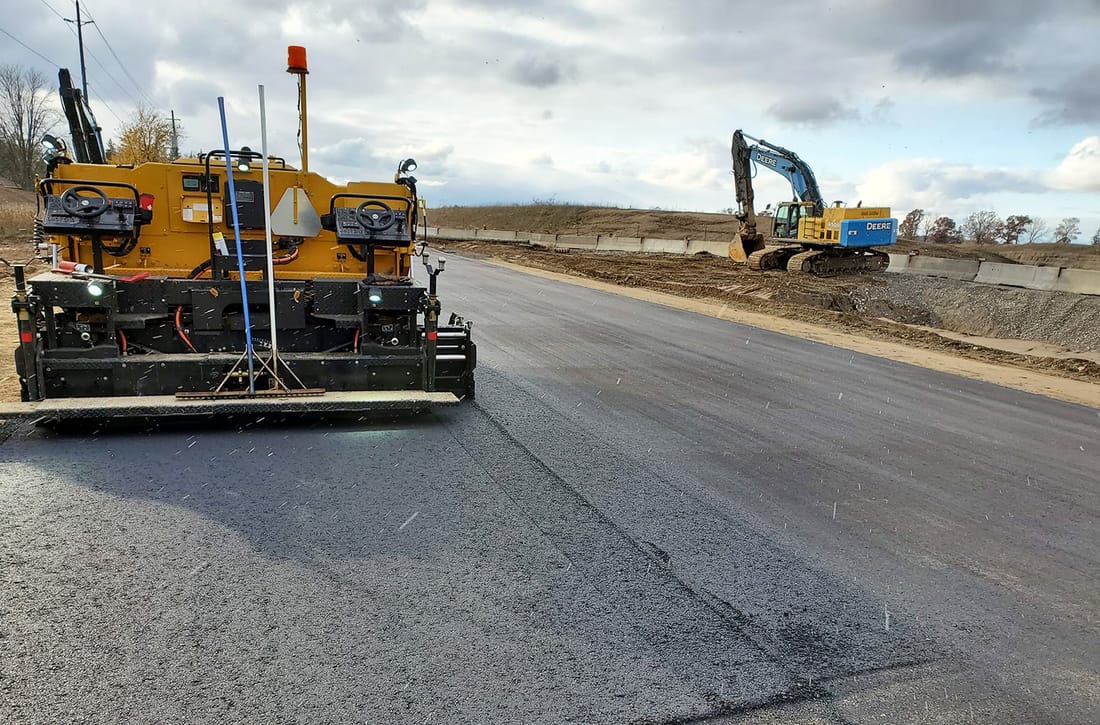
4. Asphalt placement: We pave using a mechanical paver to achieve consistent thickness and smoothness. For roads, we often use at least two lifts: a base or binder lift and a surface lift. Lifts are placed at appropriate temperatures for our climate so they can be compacted correctly before the mix cools in the desert air.
5. Compaction: Rollers follow closely behind the paver. In Chandler’s heat, we have a limited window to reach target density before the mat cools. We adjust roller patterns for intersections, curves, and cul-de-sacs so we do not overwork the mix or leave low density seams.
6. Finishing and striping: After the asphalt cools and hardens, we install thermoplastic or paint striping, crosswalks, stop bars, and any required symbols or raised pavement markers. For municipal projects, we follow the city’s traffic control and MUTCD requirements.
At each stage, we coordinate traffic control to keep residents and businesses moving as smoothly as possible. For neighborhood road paving, we phase work so people can still access homes, schools, and community amenities while we improve the streets.
Material Options and Design Choices That Matter in Chandler
Most people think of asphalt as a single product, but for road and municipal paving in Chandler there are important choices that affect performance and cost. Precision Asphalt Chandler walks clients through these options so you understand what you are paying for.
Mix design: We can use standard hot mix asphalt, polymer modified mixes for high stress areas like intersections and bus stops, or specialized mixes for higher skid resistance in school zones and sharp curves. The aggregate size and gradation are selected based on the desired smoothness, noise level, and expected traffic. For example, a tighter graded mix can provide a smoother ride on collector streets that feed into Chandler Boulevard.
Thickness and structure: A light duty residential cul-de-sac may perform well with 2 inches of surface over 4 inches of base, while a road that sees frequent delivery trucks near an industrial park may need 3 or more inches of asphalt and 6 or more inches of base. We size these layers based on estimated ESALs (equivalent single axle loads), local soil strength, and drainage.
Drainage solutions: Chandler gets intense but brief storms, especially during monsoon season. Standing water is one of the fastest ways to destroy asphalt. We set cross slopes, crown, and gutter interfaces to move water off the pavement quickly. On some municipal or private streets, we incorporate valley gutters, additional catch basins, or regraded swales to eliminate ponding you may already be dealing with.
Tie-ins and transitions: On infill projects, such as rebuilding a street in an established subdivision near Dobson Road, we pay special attention to driveways, alley tie-ins, ADA ramps, and existing utility adjustments. Smooth, properly sloped transitions prevent trip hazards, bottoming out of vehicles, and water pooling in front of driveways.
Future maintenance planning: Not every client needs the heaviest possible section on day one. For some HOAs or business parks, a smart strategy is to build a cost efficient section and pair it with a planned maintenance schedule (crack sealing and sealcoating) to control life cycle costs. We explain both premium and value options so you can choose the right balance for your budget and expectations.
Costs, Bids, and What Drives the Price of Road Paving
Road paving budgets can vary widely, and many Chandler customers want to know why one bid is higher than another. Precision Asphalt Chandler is open about the cost drivers so you can compare proposals fairly and avoid short term savings that become long term repair bills.
Scope and thickness: The largest factor is how many square yards or lane miles are being paved and how thick each layer is. A quote that uses 1.5 inches of asphalt where the city standard or engineering calls for 2.5 or 3 inches will be cheaper upfront but can fail prematurely. We always outline assumed thicknesses and base preparation in writing.
Existing conditions: Milling and overlaying an existing street that is structurally sound is far more economical than a full reconstruction. If your roads have deep base failures, widespread alligator cracking, or significant elevation problems at gutters or driveways, we may need to remove more material and rebuild, which increases cost but also resets the pavement life.
Traffic management: Maintaining access for residents, schools, and businesses can add to the cost. Night work near busy intersections, additional traffic control personnel, temporary signage, and phasing all have budget impacts. We design traffic control that keeps people safe without overspending.
Material choices: Polymer modified binders, thicker base sections, or specialty mixes for high traffic or high heat environments cost more than standard mixes. However, in Chandler’s climate, upgrading on critical sections such as bus stops, loading zones, or intersections can save significant money by reducing rutting and early repairs.
Compliance and testing: Proper density testing, core sampling, and third party inspections add accountability but also appear in the total cost. For municipal and public works projects, we factor in these testing requirements and coordination with inspectors so there are no surprises later.
When we prepare a proposal, we are happy to walk you through each line item: mobilization, milling, base work, asphalt quantities, striping, and traffic control. That transparency lets you compare apples to apples when reviewing other bids for the same road paving project.
Common Road Problems in Chandler and How We Prevent Them
Chandler’s combination of high heat, UV exposure, and rapid storm events means roads that are built like those in cooler climates will fail early. Precision Asphalt Chandler focuses on preventing the specific problems we see over and over in local streets and municipal pavements.
Rutting at intersections and stop bars: Where vehicles brake, stop, and turn, the asphalt is under constant shear. To combat rutting at signals, school entrances, and busy shopping centers, we often specify stiffer or polymer modified mixes and thicker asphalt in the wheel paths, and we ensure compaction is especially thorough in those stress zones.
Reflective cracking: If a new overlay goes directly on top of deeply cracked or jointed pavement, those cracks tend to reflect through in a few seasons. We use milling, localized base repair, and sometimes fabric or stress absorbing interlayers to slow or stop reflective cracking before placing the new asphalt.
Raveling and oxidation: With Chandler sunlight, unprotected asphalt oxidizes and becomes brittle. On some municipal or private streets, a well-timed sealcoat program can slow raveling and extend life. When we build new roads, we select binder grades that resist aging in our climate and advise owners about realistic maintenance intervals.
Poor drainage and ponding: Low spots at gutters, around manholes, or along curb returns lead to water intrusion and potholes. During construction, we set string lines or use automatic grade controls to hit design elevations, then we check for birdbaths with water tests when needed. Adjusting frame heights and feathering transitions is part of our standard punch list, not an afterthought.
Edge failures in rural or shoulder areas: On some outer Chandler roads or long drive aisles in business parks, pavement edges can break off if there is no support. We mitigate this by providing adequate shoulder support, thicker edge sections where traffic regularly leaves the travel lane, and proper compaction right to the pavement edge.
If you are responsible for an HOA network, a private roadway, or a municipal project, we can walk your site, identify which of these problems you are already seeing, and design a road paving plan that addresses root causes rather than just covering them up.